Your electric car already has a charger inside it. So what is the box on the wall for? The full guide, with the Sigenergy details, is on The Electric Shed: Sigenergy AC or DC EV charger: how each one works with your solar and battery.
The short version
- An AC wallbox converts nothing. The car's on-board charger turns AC into DC, and sets the speed: usually 7–11 kW, 6.6 kW in our GWM Ora 5, however big the wallbox.
- A DC charger converts the power itself and feeds the battery directly, skipping the on-board charger.
- One hour of charging: about 40 km from 7 kW AC, about 75 km from our 12.5 kW DC module (kW ÷ 0.17 kWh per km, best case).
- For most homes AC does the job. Look at DC for more solar than inverter, a big battery, a long cable run, or two-way charging later.
AC or DC, in a line each
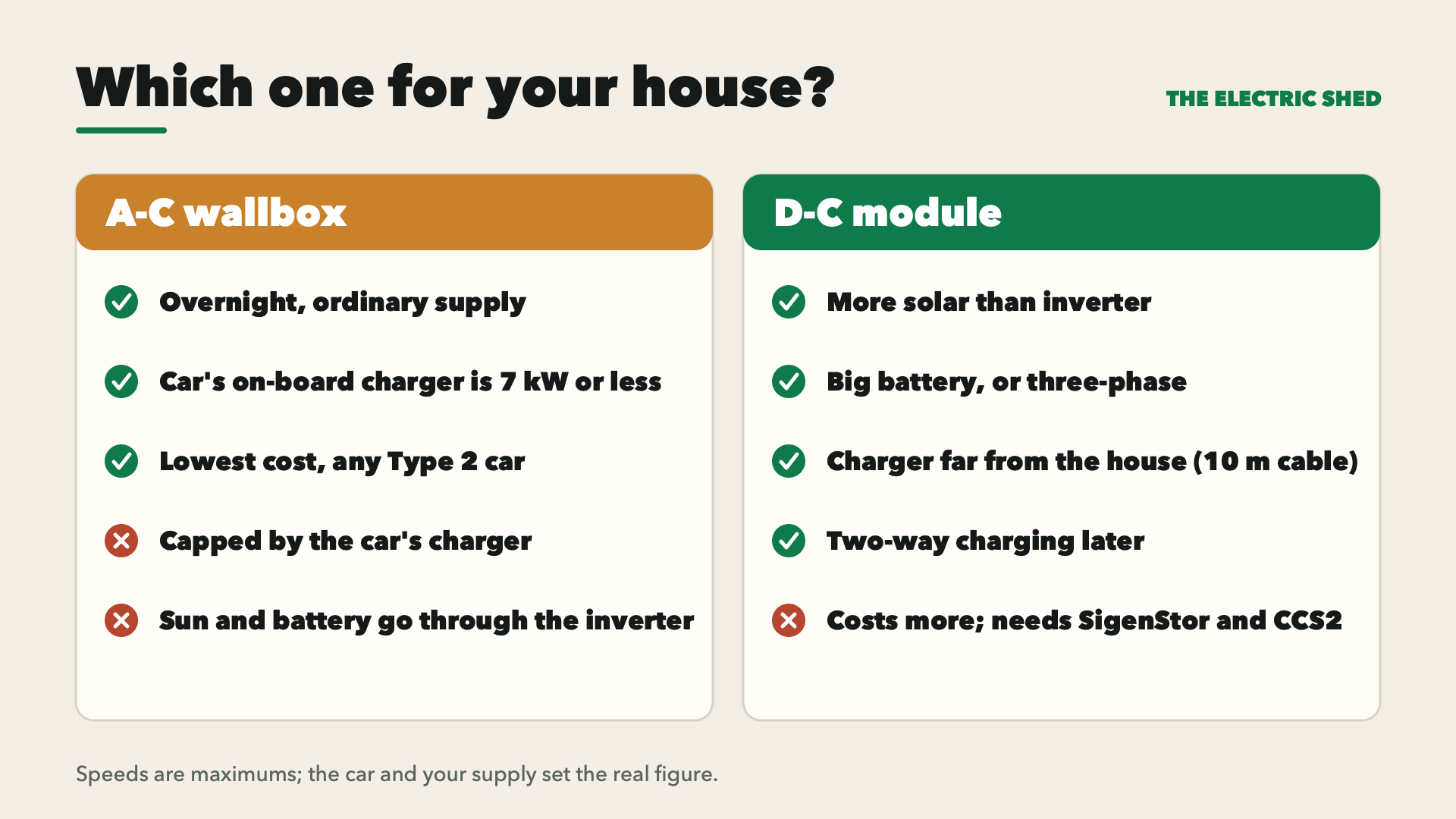
AC: cheaper, simpler, works with any car with a Type 2 plug, and plenty for overnight top-ups. It's capped by the car's own charger. DC: faster if your system can feed it, and ready for two-way charging, but it costs more and needs a CCS2 car (in New Zealand, older CHAdeMO Leafs can't use it). Our DC charger at home post has the owner's view.
Our system and data are from New Zealand. Our DC charger is real; we have not used Sigenergy's AC charger, so that side is researched. See the full guide for sources, and charging an EV from solar: a real day for what it looks like.
Sources
- Sigenergy datasheets for the Sigen EV AC Charger and EV DC Charging Module; SolarQuotes, Sigenergy EV charger reviews (read 26 October 2026).
- Our own data: the channel's dashboard, 12 September – 18 October 2026, New Zealand.
Diagram: The Electric Shed.