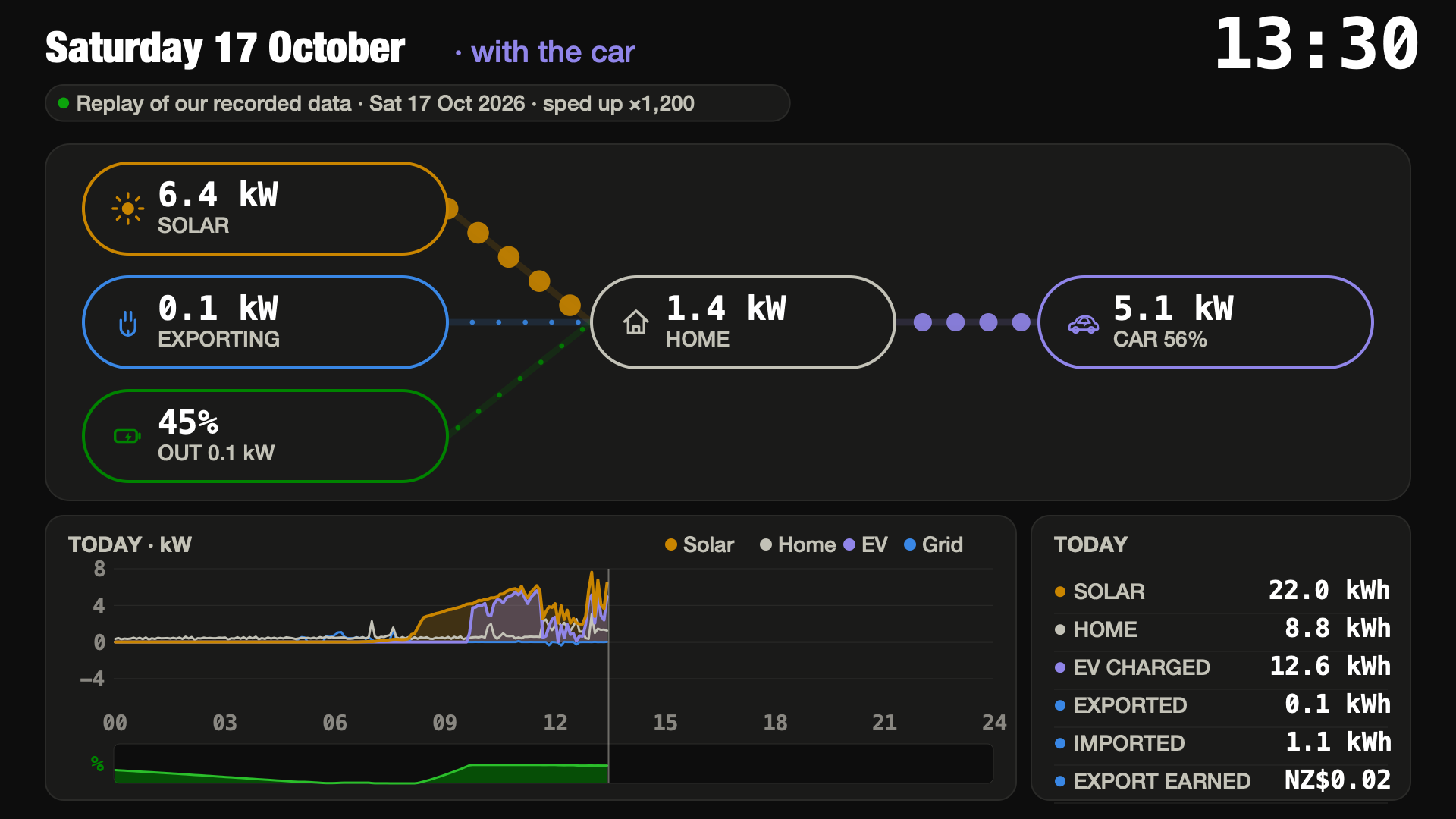
What does charging an EV from your own roof actually look like? We replayed a sunny Saturday from our home system's data: the car plugged in mid-morning and soaked up the sunshine all day. The full story, with a second day for comparison, is on The Electric Shed: A day in our solar house, with and without the EV.
The short version
- 22.4 kWh into the car in one sunny day, 21 kWh of it straight from the roof: about 140 km of driving in our Ora 5 (16 kWh/100 km).
- It charged at 3–6 kW, following the sun, from 9:43 am to 3:48 pm.
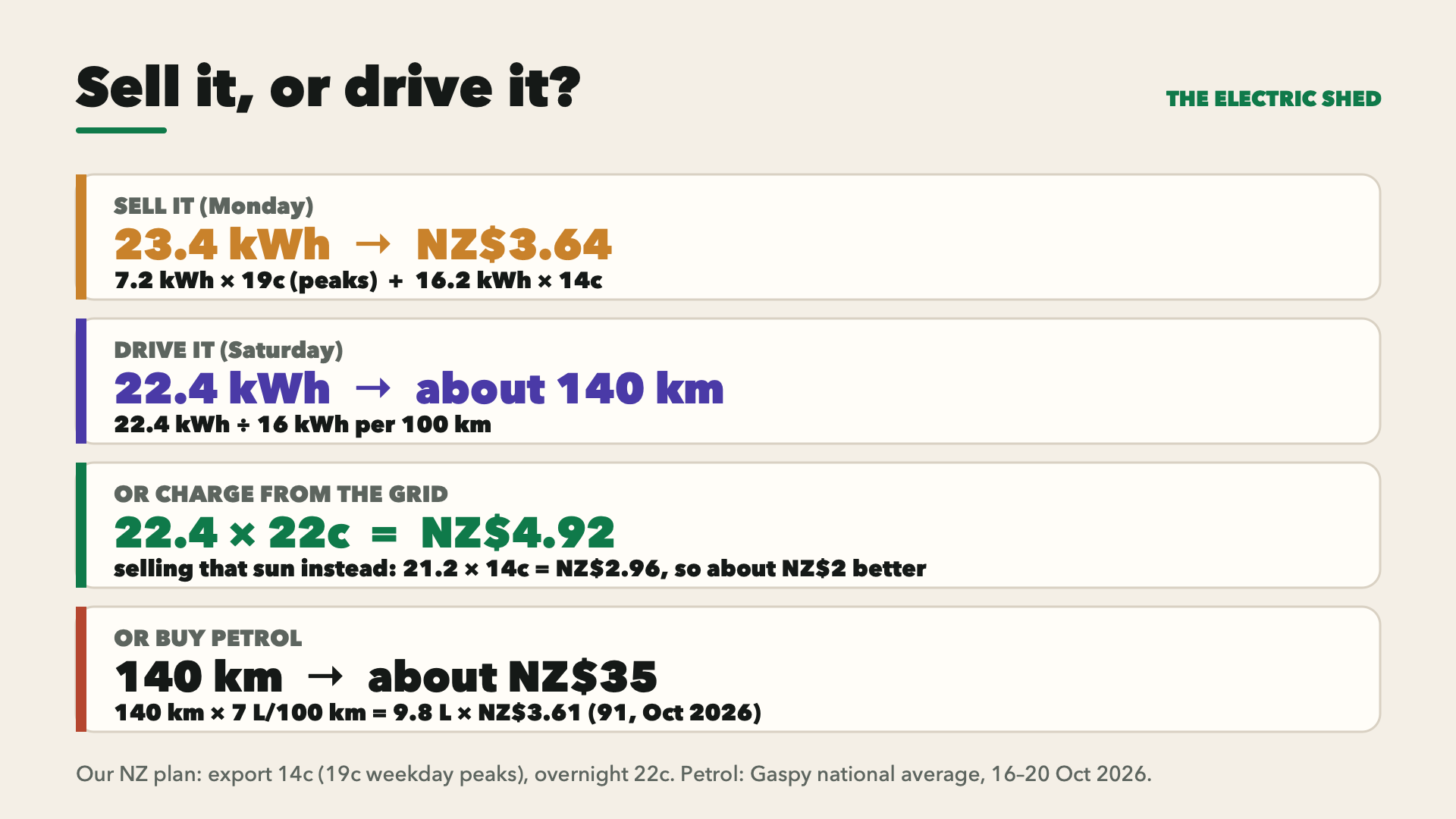
- It saved about NZ$2 against charging overnight from the grid, and about NZ$35 against petrol for the same distance.
- The catch: on car days, the home battery doesn't fill. Ours stayed at 46% while the car charged and reached 76% by sunset.
The day
- 9:43 am: plugged in. The home battery had already taken the early sun and was about 40% full.
- Midday: a few clouds; the charging rate rose and fell with the sun, between about 3 and 6 kW.
- 3:48 pm: done, with the car at 71% (from 38%). The home battery then filled to 76% by 7 pm and ran the house overnight.
- All day, we bought 1.3 kWh from the grid (NZ$0.33) and sold almost nothing.
What it was worth
- Instead of the grid overnight: 22.4 kWh × 22c = NZ$4.92. Selling the same sunshine would have earned about NZ$2.96 at our 14c export rate. So the sunny charge was worth about NZ$2.
- Instead of petrol: 140 km at 7 L/100 km is 9.8 L; at NZ$3.61/L (91, October 2026), about NZ$35.
The rule of thumb: compare what export pays you with the cheapest other way you can charge. In New Zealand and Australia, where feed-ins are low, charging from the sun usually wins. On a Solar Sharer plan in NSW, south-east Queensland or South Australia, midday grid power is free for three hours anyway.
If you're charging at home, our GWM Ora 5 review covers how this car charges, and how long EV batteries last covers what years of charging do to the battery.
Sources
- The Electric Shed, A day in our solar house, with and without the EV: full sources and data.
- Our own data: home system and charger, New Zealand, Saturday 17 October 2026.
- Petrol: Gaspy national average for 91, 16–20 October 2026, via RNZ.
Diagrams and replays: The Electric Shed.