"What about the battery?" is still the first question people ask about electric cars, usually followed by a story about a phone that wouldn't last a day by its third birthday. Here's what the real-world data says now, and why a car battery has a much easier life than your phone's.
The short version
- About 2.3% a year. That's the average capacity loss across more than 22,700 EVs, so expect about 80% or more after eight years.
- Fast charging adds wear, but not much: about one percentage point a year for the heaviest users.
- Battery replacements are rare, especially in cars built in the last few years.
- LFP or NMC? Both last well in a car. The bigger differences are weight, cold-weather charging and price.
What the data says
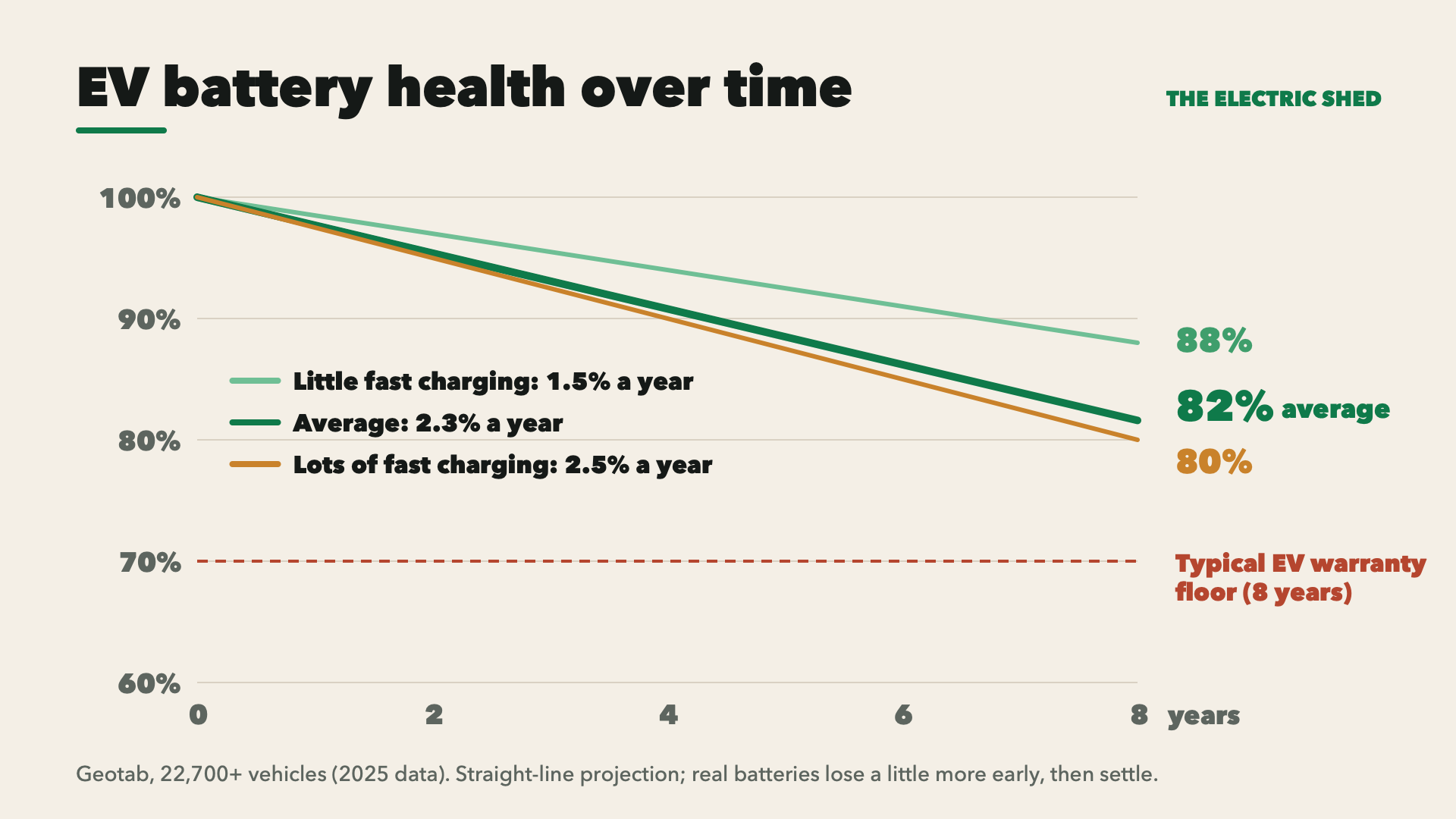
- Geotab (2025 data, published January 2026) tracked more than 22,700 EVs in North America and Europe. The average battery lost about 2.3% of its capacity a year. Cars that used high-power DC fast charging for more than 12% of their charging averaged about 2.5% a year; the rest, about 1.5%. Hot climates added a few tenths of a per cent.
- Stanford and SLAC (Nature Energy, December 2024) found that realistic driving, with acceleration, braking and parking, is gentler than the constant cycling used in lab tests. Their cells lasted up to 38% longer.
- Tesla's own figures put the loss for Model S and Model X at about 12% after 200,000 miles (around 320,000 km).
- Recurrent (via InsideEVs) found replacements outside of recalls to be uncommon, and much rarer in newer cars than in the first generation of EVs.
What does 2.3% a year mean on the road? A car with a 400 km range when new would have about 330 km after eight years. Most new EVs come with a battery warranty of around eight years, often 160,000 km, usually to 70% capacity.
Why your car isn't your phone
- Phones use almost the whole battery, sit at 100% overnight, get hot in pockets and have no cooling.
- EVs have a battery management system watching every group of cells, and most have liquid heating and cooling. They hide a buffer at the top and bottom, so "0%" isn't truly empty, and they slow fast charging as the battery fills.
LFP or NMC in a car?
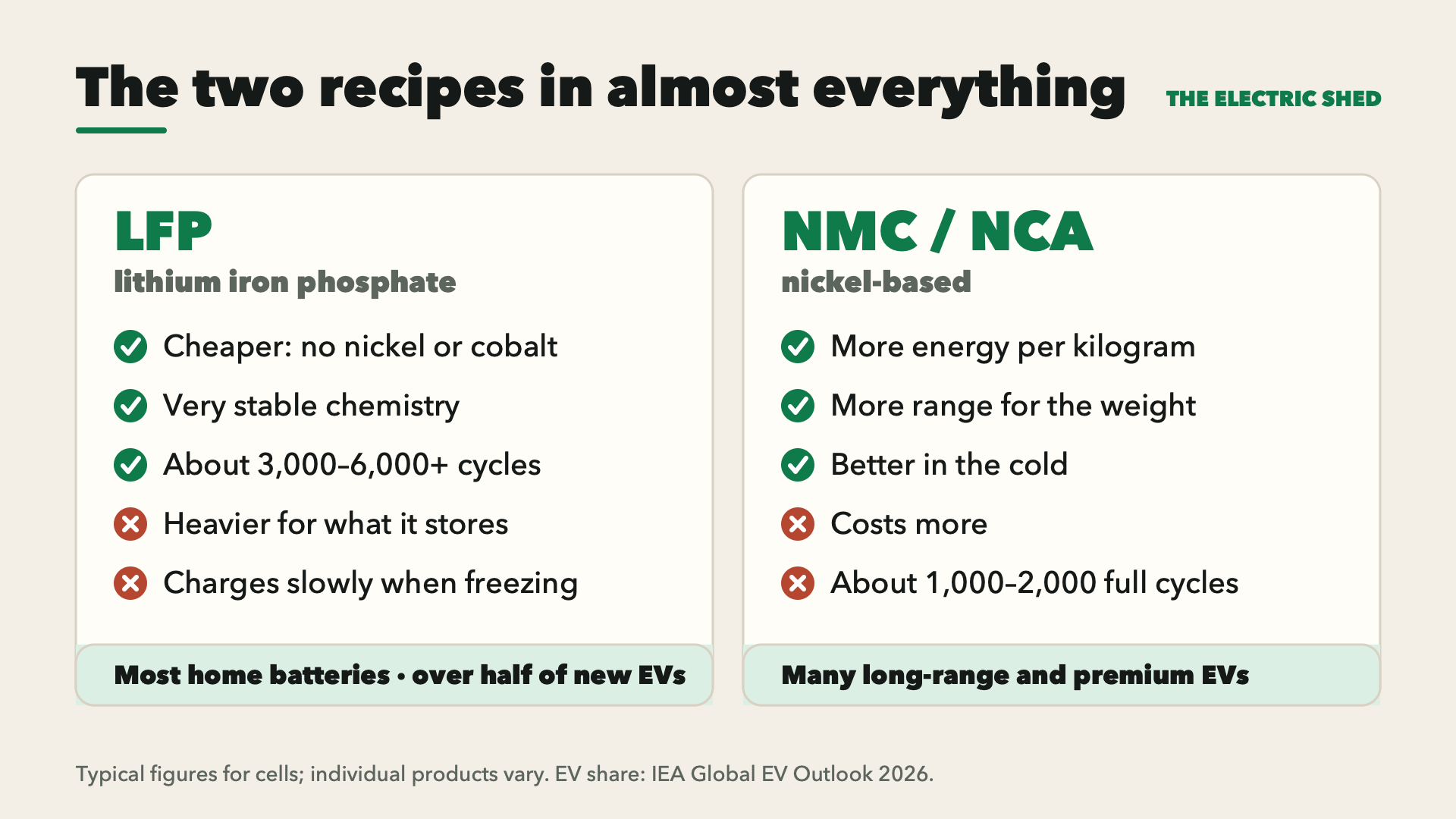
- LFP (lithium iron phosphate) is cheaper, very stable and handles thousands of cycles. It's heavier for what it stores and charges more slowly when it's below freezing, which matters if your car lives outside in a cold winter. LFP cars usually tell you to charge to 100% regularly.
- NMC/NCA (nickel-based) stores more energy per kilogram, so it suits long-range cars, and copes better with the cold. It's rated for fewer cycles, but in a car that hardly matters: 1,000 cycles at 400 km a charge is 400,000 km. These cars usually suggest 80–90% for daily use.
Whichever you have, follow the manual, and avoid leaving the car fully charged in the heat for long stretches.
Should you wait for a better battery?
The first sodium-ion cars were announced in 2026, and solid-state batteries are targeted for 2027–28 in a few premium cars, with mass-market models more likely in the 2030s. Better batteries will always be coming, and today's are already lasting longer than most people expected. If an EV suits you now, the battery isn't a reason to wait.
For the full comparison, including home batteries, sodium-ion and lead-acid, see battery types explained on The Electric Shed.
Diagrams: The Electric Shed.