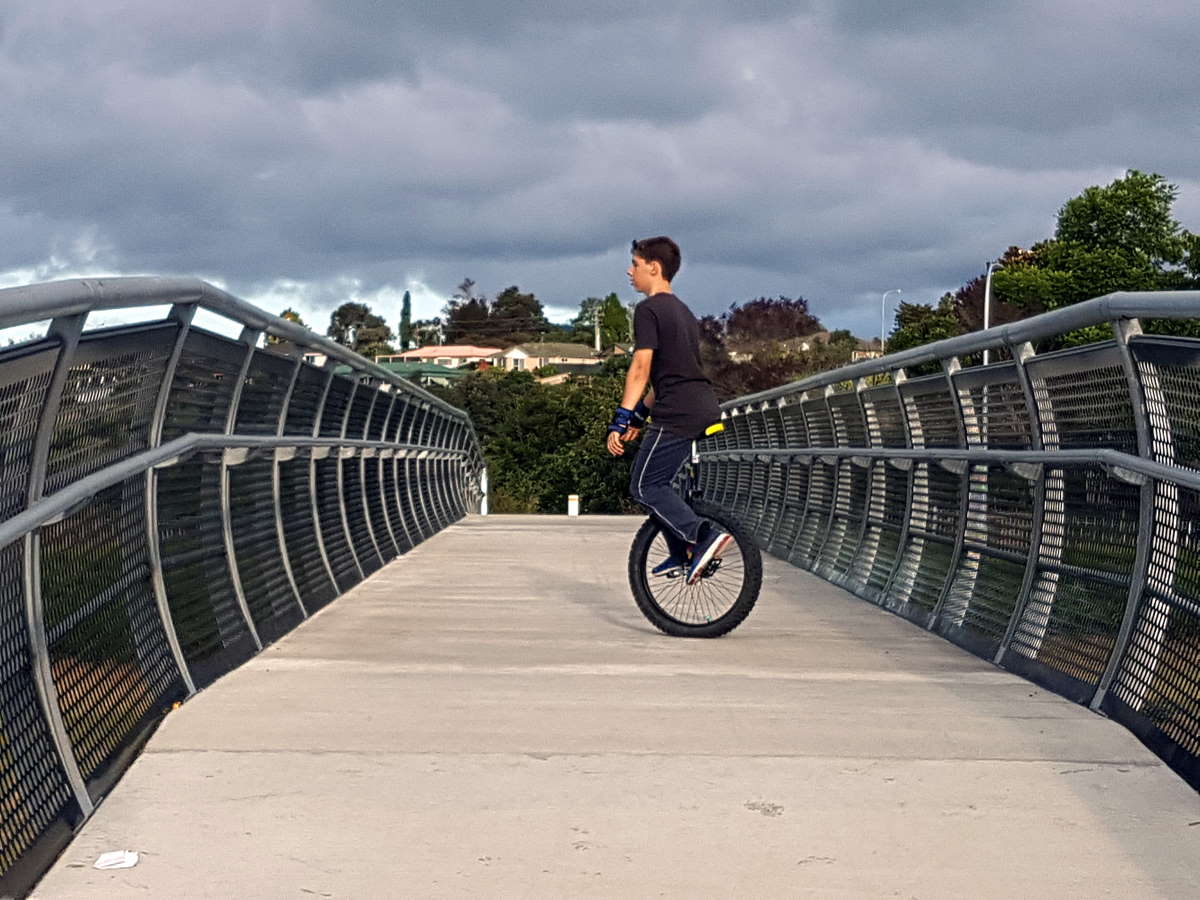
If a bike is too awkward to carry on the train, store at work or lock up outside, there's a smaller option that a dedicated few swear by: one wheel.
Can you unicycle to work?
Yes. A unicycle can go most places a bike can, and the mechanics really are as simple as they look. But getting the right one for commuting takes a little thought, and learning to ride one takes practice: expect weeks, not days.
Why unicycle?
- Simple and reliable. One wheel, one hub, two pedals and a seat. There's not much to go wrong.
- Portable. A typical unicycle weighs about 7 kg (15 lb) or less, and can be carried in one hand. On many buses and trains where bikes aren't allowed, nobody will look twice at a unicycle (but check the rules where you are). Students can hop across campus and carry it into the lecture theatre.
- Cheap to own. Tyres are usually the only part that needs regular replacing. Good second-hand unicycles turn up on eBay, Facebook Marketplace and Craigslist.
Is it efficient?
Unicycling is faster than walking, but much less efficient than riding a bike. A normal bike has gears to suit your speed and the slope, and it freewheels: you can rest going downhill. Most unicycles have one fixed gear. The pedals are attached directly to the wheel, so the only way to control your speed, including slowing down, is through the pedals. On a unicycle you're always working, uphill, downhill and on the flat.
Does a unicycle freewheel?
Almost all unicycles are fixed-wheel, with no freewheel. A few specialist hubs do freewheel. If you buy or build one, fit a disc or rim brake as well, because without the pedals you have no other way to control your speed.
Do unicycles have brakes?
Many ranges include models with disc brakes, but usually only on some models, so check the specification. The setup is like the front brake of a bike: a disc on the hub and a hydraulic brake lever mounted under the front of the seat.
A brake takes some load off your legs on long descents, which you'll appreciate on a hilly route. With practice, it also lets you hold position at traffic lights without getting off. Trials and mountain unicyclists use brakes for hopping and riding down steps and rocks, too.
Can you add gears?
Yes, but at a price. Kris Holm and the Swiss company Schlumpf make a two-speed hub for unicycles, the KH/Schlumpf geared hub. You change gear by tapping a button on the side of the hub with your heel. The current version, redesigned in 2023, gives a choice of 1:1 or 1.5:1 gearing, takes a hub-mounted disc brake, and comes in both 100 mm and 125 mm bearing spacing. It needs a compatible frame with a left-side disc mount.
The higher gear makes a smaller wheel ride like a bigger one, so you can keep a compact, easy-to-carry unicycle and still cover ground at a decent speed. The hubs are built in small batches and are expensive, so you may wait for one.

What size unicycle for commuting?
Unicycles are named by wheel size, so a "KH 24" has a wheel of about 24 inches (61 cm).
- 24-inch: a great choice for the last mile from a bus, train or ferry. Compact and easy to carry. The original author's son regularly rode 10 km (6.2 miles) on one without trouble.
- 26-inch: a bit faster and still fairly easy to carry and manoeuvre. A good all-rounder.
- 29-inch: each pedal turn covers more ground, so you can go faster at a comfortable cadence. Better for longer commutes.
- 36-inch: the long-distance touring size. Fast, but hard to handle in busy, unpredictable traffic and awkward to carry. Best left for touring, not commuting.
Staying safe in town
Unicycles have one big safety advantage: when things go wrong, you simply step off the front and let the unicycle fall. There's no going over the handlebars as there can be on a bike. Unicycle seats have plastic bumpers at the front and back for exactly this reason.
The awkward part is fitting lights and a bell, as there are no handlebars:
- Rear light: clips onto the seat post.
- Front light: a headlamp on your helmet works well.
- Bell: under the seat, on the seat post, or on your finger. Finger-mounted bells exist.
For longer commutes, touring handlebars give you more mounting points and a more comfortable riding position.
Safety gear
- Shin guards are a must for all but experienced riders. Pedals hitting shins and calves is common when learning, and it hurts.
- Wrist guards are cheap and light, and worth wearing while you're learning: your hands and wrists take most falls.
- A helmet. Unicycles often aren't legally classed as bicycles, so cycling rules may not apply, but following them is the simplest and safest approach.
Maintenance
Unicycles need little maintenance, but they do need it regularly.
- Before each ride: check the seat post clamp and any quick-release levers.
- Weekly: check the pedals for damage, cracks or wobble, and check that the hub is secure with no play or roughness in the wheel.
- Bearings are sealed and not meant to be serviced. Don't spray oil or lubricant into them; extra grease usually makes them run worse. If you track a wobble or roughness to the bearings, replace both sides.
- Cleaning: wash weekly with warm soapy water and rinse gently. Don't use a pressure washer; water gets into the bearings and hard-to-dry parts of the frame. Most unicycle frames are steel, so dry it well to prevent rust.
Rotate the tyre
Because the wheel is fixed, you start and stop at the same points on the tyre, so it wears unevenly. Every couple of months, let some air out, rotate the tyre around the rim, and pump it back up. It'll last longer and ride more smoothly.
Which brand to buy?
A very simple rule avoids most disappointment: stick to well-known unicycle brands such as Nimbus, QU-AX and Kris Holm. Generic, unbranded unicycles are often poorly made and frustrating to learn on. A second-hand unicycle from one of these brands is usually a better buy than a new no-name one.
What about electric unicycles?
Since this article was first written, electric unicycles (EUCs) have become a serious commuting option for some people. They're self-balancing, with a battery and motor inside a single large wheel, and they're nothing like a pedal unicycle to ride: you stand on fold-out footplates and lean to accelerate and brake. The bigger models are heavy (often 20–35 kg, or 45–75 lb), fast, and claim ranges of tens of kilometres.
They're also in a legal grey area in many places. In the UK, for example, they're treated as motor vehicles but can't be registered or insured, which in practice means they can't be ridden legally on public roads or footpaths. Rules in the US vary by state. Check your local law before buying one for commuting. They're a topic for another article.
This article is a 2026 rewrite by Cole of Mark's 2019 original, with the geared hub details updated and electric unicycles added.