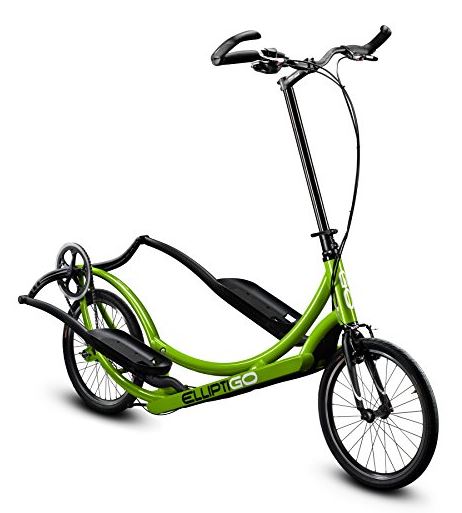
Most bikes ask you to sit down. A small but loyal group of commuters would rather not. Stand-up bikes come in two main types: elliptical bikes, which move your feet like a gym cross-trainer, and stand-up bikes (sometimes called SUBs), which keep a normal circular pedal stroke but drop the saddle. Here's what they are and whether one makes sense for getting to work.
Elliptical bikes: the cross-trainer, outdoors
Elliptical bikes have been on the market since around 2010. Instead of turning cranks in a circle, you stand on two long platforms that move in an oval path, the same motion as the cross-trainer at the gym. The motion drives the rear wheel through a chain and, usually, a hub with several gears.
They come in two main stride styles:
- Long stride: a longer, smoother, running-like motion. These bikes are long, which makes them stable at speed but harder to store and manoeuvre.
- Compact or short stride: a shorter, more stepping motion and a shorter bike, which is easier to fit in lifts, trains and small storage spaces.
They also come with two or three wheels. The two-wheelers ride like a bike. The three-wheelers, with two wheels at the front, lean through corners and stand up on their own when stopped, a bit like the trikes many of us rode as children.

The best-known maker, ElliptiGO, pioneered the category with its first model in 2010 and said in 2018 that it had 25,000 bikes on the road. It's still selling them in 2026, alongside its newer stand-up bikes.
Stand-up bikes: a normal pedal stroke, no saddle
Stand-up bikes keep the familiar circular pedal motion of a normal bike. You simply ride standing, as you would climbing a hill out of the saddle, with a frame designed for it. That makes them simpler, lighter and shorter than elliptical bikes, with standard bike parts throughout.
ElliptiGO's current range includes a road stand-up bike (the RSUB) and an off-road version (the MSUB). Its own site lists them at US$1,499 and US$1,799 respectively, at the time of writing.
What's good about riding standing up
- More of a workout. ElliptiGO cites a metabolic study by the Exercise and Physical Activity Resource Center at the University of California, San Diego, which found that riding an elliptical bike burned on average 33% more calories than a conventional bike at the same speed. The same study found that riding at 26.5 km/h (16.5 mph) took about the same effort as running at roughly 5 minutes per kilometre (8 minutes per mile).
- Low impact. The smooth motion is easy on backs, hips, knees and ankles, which is why runners recovering from injury like them.
- No saddle soreness, and no hunched position to strain your neck and lower back.
- A fuller-body workout. Standing engages your core and upper body as well as your legs.
- You see more, and are seen more. Your head is well above car roofs, which helps at junctions.
What to weigh up for a commute
That extra workout cuts both ways. If you want to arrive at work fresh, a bike that burns a third more energy at the same speed means more sweat, or a slower ride. There are other trade-offs too:
- Size and storage. Long-stride elliptical bikes are well over 2 metres (6.5 ft) long and can be awkward on trains, in lifts and in bike racks. Compact models and stand-up bikes are easier.
- Weight. Elliptical bikes are heavier than a normal commuting bike.
- No sitting down. There's no resting at the lights or on long flat sections. Most riders say you adapt quickly, but long commutes take some building up.
- Price. They cost more than a good conventional commuter bike, and there's a smaller second-hand market.
- Servicing. The drive mechanisms on elliptical bikes are specialised, so check that a local shop can service one before you buy.
The verdict: for a short to medium commute, especially if you want your ride to double as your workout, a stand-up or elliptical bike is a genuinely fun alternative. If you want to arrive cool and dry, a conventional bike, or an e-bike, is the easier choice. Most dealers will let you try one, and it's worth doing before you buy: the first few minutes feel strange, and then most people grin.
This article is a 2026 rewrite by Cole of Ian's 2019 original.